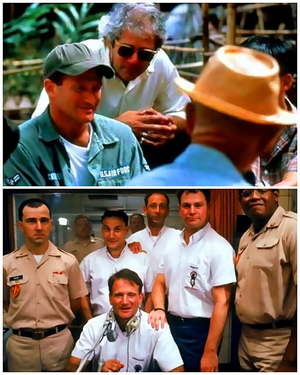
The sound crew was trying to check levels when Robin Williams grabbed the microphone and began announcing a completely imaginary garage sale for leftover jungle props. He shifted accents mid-sentence, turned a plastic vine into a luxury item, and ended by auctioning off the director’s chair in the voice of a Shakespearean villain. The slate had not even clapped yet. Half the crew was already bent over laughing.
That was a normal morning.
On “Good Morning, Vietnam” (1987), director Barry Levinson often kept cameras rolling far beyond the script. Williams would sit at the radio desk and unleash a torrent of improvised broadcasts, weaving impressions, political satire, and absurd jingles into one seamless rush. The written lines became scaffolding. The real magic lived in the riffs between them.
During recording sessions for “Aladdin” (1992), animators found themselves scrambling to keep up. Williams did not simply voice the Genie. He detonated into it. He jumped from celebrity impressions to rapid cultural jokes, inventing entire comic tangents that were never storyboarded. The creative team later admitted that many of the Genie’s most memorable bits were born in those spontaneous bursts. They animated around his mind.
On “Mrs. Doubtfire” (1993), cast members braced for impact before every take. Williams would honor the emotional core of a scene, then slip in a new aside, a sly glance, or a perfectly timed extra line that sent everyone off balance. Crew members have recalled how difficult it was to maintain composure. The outtakes tell the story. Laughter spills into the frame. The atmosphere feels less like work and more like recess.
He treated film sets like living comedy labs. Microphone tests became mini stand-up sets. Lighting adjustments turned into improvised monologues. If a child actor looked nervous, he launched into cartoon voices until the tension dissolved. A long day of production can grind people down. Williams seemed determined to lift it.
The playfulness had structure underneath. He trained seriously, understood timing, and knew when to rein himself in. Directors trusted him because, even in chaos, he landed the scene. His improvisation was fast but not careless. He sensed emotional beats and rarely stepped on them.
Still, the velocity was constant. Silence rarely lingered around him. Colleagues often described how he filled empty spaces instinctively. Between setups, during resets, in makeup chairs, the performance never entirely powered down. Humor flowed like a reflex.
That reflex may have been more than entertainment. Comedy had always been his language. As a stand-up, he learned to scan a room and respond instantly. On set, that instinct turned pressure into play. If energy dipped, he raised it. If the mood grew heavy, he lightened it. Laughter became a shared currency.
There were quieter sides, too. In films like “Good Will Hunting” (1997), he proved he could sit in stillness and let emotion breathe. The restraint surprised audiences who knew him for whirlwind comedy. It also revealed that the noise was a choice, not a limitation.
Yet many who worked with him sensed that humor served as a shield as much as a gift. Filling space meant never sitting too long with emptiness. Noise kept the world moving. Jokes kept connection alive.
And on those sets, connection mattered. Crew members have said he remembered names, checked in on families, and made the lowest-paid assistant feel visible. The playground atmosphere was not random mischief. It was generosity in motion.
He made laughter contagious. He made work feel lighter. He made ordinary days feel electric.
He turned film sets into playgrounds, and in doing so, left behind echoes of joy that still outlast the final cut.