
You are using an out of date browser. It may not display this or other websites correctly.
You should upgrade or use an alternative browser.
You should upgrade or use an alternative browser.
Animals Thread (Animals are better than people)
- Thread starter Dingleberry
- Start date


HSanders
Well-known member
I don't know, but I wish they were. They serve absolutely no useful purpose. All they are is destructive. And i'm pretty sure any place they have on the food chain could be adequately filled in by something else




But they're yummy!I don't know, but I wish they were. They serve absolutely no useful purpose. All they are is destructive. And i'm pretty sure any place they have on the food chain could be adequately filled in by something else
HSanders
Well-known member
i didn't care for the venison that I ate but maybe it wasn't prepared properly.But they're yummy!



HSanders
Well-known member
HSanders
Well-known member
HSanders
Well-known member



We assume cats purr because they are happy. But cats also purr when they are injured or dying. Why? Because purring is a Bio-Mechanism for Self-Repair.
Research shows that the frequency of a domestic cat's purr falls exactly between 25 Hz and 150 Hz. This is the "Goldilocks Zone" for vibrational therapy. Scientists have found that sound frequencies in this specific range:
Increase Bone Density: They stimulate osteoblasts to lay down new calcium.
Repair Tendons: They speed up soft tissue recovery.
Reduce Pain: They act as a mild analgesic.
When a cat sits on your chest and purrs, they are essentially giving you an ultrasound therapy session. Studies show that cat owners have a 40% lower risk of heart attack than non-cat owners. The purr lowers your blood pressure and cortisol simply by resonance.
 Vital Insight: The Astronaut Connection: NASA has studied vibrational therapy to prevent bone loss in astronauts in zero gravity. The frequencies they use to keep astronaut bones strong? The same frequencies as a cat's purr. Nature solved the problem millions of years before NASA did.
 Source: Journal of the Acoustical Society of America, "The felid purr: A healing mechanism?", Bioacoustics Analysis.
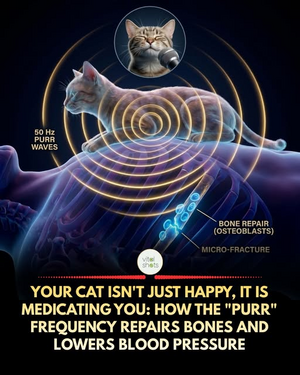
Research shows that the frequency of a domestic cat's purr falls exactly between 25 Hz and 150 Hz. This is the "Goldilocks Zone" for vibrational therapy. Scientists have found that sound frequencies in this specific range:
Increase Bone Density: They stimulate osteoblasts to lay down new calcium.
Repair Tendons: They speed up soft tissue recovery.
Reduce Pain: They act as a mild analgesic.
When a cat sits on your chest and purrs, they are essentially giving you an ultrasound therapy session. Studies show that cat owners have a 40% lower risk of heart attack than non-cat owners. The purr lowers your blood pressure and cortisol simply by resonance.
Similar threads

- Replies
- 272
- Views
- 4K


