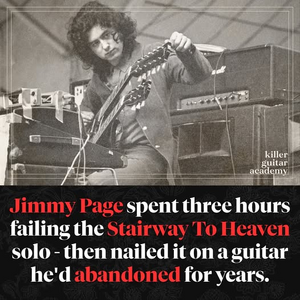
By January 1971, Jimmy Page had a problem.Led Zeppelin was holed up at Headley Grange, a drafty Victorian poorhouse in Hampshire they'd converted into a recording space. The fourth album was taking shape - "Black Dog" with its triple-tracked Les Paul riffs, "When the Levee Breaks" with Bonham's thunderous drums in the stairwell. But "Stairway to Heaven" was stuck.The song had everything else. Page had composed the acoustic introduction in Wales. John Paul Jones had worked out the recorder parts. Robert Plant had written most of the lyrics in a single sitting. The track built from delicate folk through electric twelve-string into a full rock crescendo. It just needed one thing: the solo.Page tried for three hours. Take after take, he couldn't get it right. The climax that was supposed to crown the song's eight-minute journey kept falling short. Finally, he gave up. The solo would have to wait.Weeks later, the band returned to Island Studios in London to finish overdubs. Page cleared the room - he liked to work alone when recording solos, letting concentration replace an audience. Engineer Andy Johns set him up in front of giant Tannoy monitors instead of headphones, the big orange Lockwood cabinets simulating the feel of a live band.Page didn't reach for his 1959 Les Paul, the guitar he'd used for nearly everything on the album. He'd been playing it for months on these sessions, building those massive riffs, layering the heavy rhythm tracks. But for this solo, he wanted something different. A tone that could cut through the fatter Gibson sound underneath.He pulled out an old Fender Telecaster.Jeff Beck had given him this guitar back in June 1965, showing up at Page's parents' house in Epsom and handing it over as thanks for helping him land the Yardbirds gig. Page had painted it with a psychedelic dragon, used it as his main guitar through the Yardbirds era, recorded most of the first Zeppelin album with it. Then he'd set it aside. By 1971, he hadn't played it in a couple of years.But Page believed this Telecaster carried something beyond its specifications. He later described it as "a talisman" that possessed "a strange power of its own."He plugged the Telecaster into a small Supro amp - the same setup that had delivered the killer crunch on Led Zeppelin I. Johns watched as Page leaned against one of the massive speakers, cigarette in his mouth, and started warming up.Page had the first phrase worked out, plus a link phrase or two. The rest he planned to improvise. He saw the solo as "almost like a meditation on the song" - finding a piece of filigree that played "in total empathy with everything else that's going on."Johns noticed Page getting tense. The pressure was building. A few passes weren't working. "I could see he was getting a bit paranoid," Johns recalled, "and so I was getting paranoid... It was a silly circle of paranoia."Then bang. Page ripped it out.