The wind hit you first.
Not the polite kind that messes up a kickoff. The Foxboro Stadium wind. The kind that found the gap between your jacket and your neck and stayed there for three hours like it paid rent.
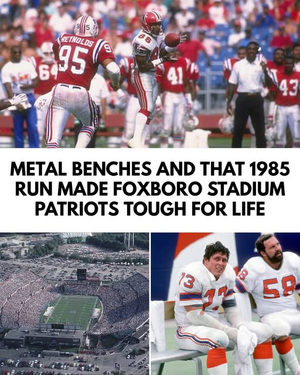
Then came the benches.
Those old metal planks weren’t seats, they were a dare. You didn’t sit so much as you endured. You shifted. You stamped your feet. You tried to laugh about it while your coffee turned into a sad, lukewarm memory by the end of the first quarter.
And somehow, in 1985, that whole rough, rattling, blue-collar mess became a badge of honor.
Because that season didn’t just give Patriots fans a Super Bowl trip. It gave us a reason to puff our chests out about the old place. Foxboro Stadium wasn’t pretty, wasn’t comfortable, wasn’t even particularly kind. But it was ours. And for one unforgettable winter, it felt like the toughest ticket in the AFC.
You remember what the team was supposed to be back then. Not a powerhouse. Not a dynasty. Just a franchise still trying to figure out what it wanted to be in a league that didn’t care about your feelings.
Then Raymond Berry showed up with his calm, no-nonsense vibe, and the 1985 Patriots started stacking wins in a way that felt almost suspicious. They finished 11-5, and even that doesn’t capture the weird magic of it. This was the year the defense turned into a pack of thieves, led by guys like Andre Tippett and Steve Nelson, and the offense had just enough bite with Tony Eason and Craig James to make it work.
And of course, the heartbeat of the whole thing was John Smith.
If you went to games at Foxboro Stadium, you don’t need me to explain why that name still hits. Smith wasn’t just the kicker. He was the guy who made the cold feel survivable because every time the offense stalled out, you knew points were still on the table.
The 1985 postseason is remembered for the road games, and it should be. That run was a traveling bar fight.
First came the Jets in the Wild Card on December 28, 1985. Patriots 26, Jets 14. The pick-sixes were the stuff of legend, with rookie Ronnie Lippett and veteran Ray Clayborn both taking one to the house. Foxboro Stadium got loud in that old-school way, the kind of roar that didn’t come from video boards and scripted prompts. It came from people who had been waiting years for something to finally break their way.
Then the famous one. The AFC Divisional in Los Angeles on January 5, 1986. Patriots 24, Raiders 21.
That game is still a fever dream. The Raiders were the defending Super Bowl champs, and the Patriots went into the Coliseum and won on a John Smith field goal with 0:06 left. That’s the kind of kick that turns a season into a story your uncle tells forever.
And then came Miami.
If you’re a Patriots fan of a certain age, you don’t even have to say the whole sentence. You just say “Miami” and everyone knows.
The Dolphins owned us. Owned us in a way that felt personal. The Orange Bowl was a haunted house. But on January 12, 1986, the Patriots walked in there for the AFC Championship Game and did the thing nobody believed they could do. Patriots 31, Dolphins 14.
Tippett was a menace. The defense hit like it had been insulted. And the stat that still makes people blink is that New England ran for 255 yards. Craig James went for 105. Tony Collins added 100. That wasn’t finesse. That was a team deciding it was done being pushed around.
That win didn’t happen in Foxboro Stadium, but it belonged to Foxboro Stadium.
Because that’s what the old place did. It hardened you. It made you proud of the ugly parts. It made you feel like you earned it.
Foxboro Stadium wasn’t a destination. It was a pilgrimage. You fought traffic, you fought the cold, you fought those benches, and you fought the feeling that the league’s real glamour lived somewhere else.
And when the Patriots finally punched through in 1985, it felt like a reward for all those Sundays when you went home half-frozen and still told yourself it was worth it.
People love to romanticize the old stadium now, but nobody was romanticizing it while their back was locked up from sitting on metal for three hours. What made it special wasn’t comfort. It was the shared suffering. The sense that Patriots fandom wasn’t something you put on like a clean jersey. It was something you wore like a work jacket.
That’s why 1985 matters so much to the Foxboro Stadium era.
Not because it ended with a Lombardi. It didn’t. The Bears took care of that in Super Bowl XX. But even that blowout didn’t erase what came before it. If anything, it sharpened the point.
Foxboro Stadium taught a whole generation of Patriots fans how to be loyal without needing things to be perfect. How to show up when the product was inconsistent and the weather was worse. How to make a rough venue feel like home because home is where your people are.
Gillette is beautiful. It’s loud. It’s modern. It’s everything the franchise deserved after all those years.
But Foxboro Stadium was the place that made Patriots fans.
Metal benches, knife-edge wind, and a 1985 run that proved toughness could be a tradition, too.