When Rob Gronkowski was healthy, the NFL didn’t have an answer.
Linebackers were too slow. Safeties were too small. Cornerbacks had no chance once he got moving down the seam. If you tried to tackle him one-on-one, he ran through you.
For a few seasons, the Patriots had the most unfair offensive weapon in football.
Rob Gronkowski.
The connection with Tom Brady turned New England’s offense into a nightmare for defensive coordinators. In the red zone, it felt automatic. Throw the ball high, let Gronk box out the defender, and celebrate.
But the physical style that made Gronkowski unstoppable also made him vulnerable.
By the time the Patriots reached the 2011 season, Gronk had already redefined what a tight end could do. He caught 90 passes for 1,327 yards and 17 touchdowns, setting the single-season record for touchdown receptions by a tight end.
He wasn’t just catching passes.
He was dominating games.
The Patriots rode that offense all the way back to the Super Bowl, setting up a rematch with the New York Giants in Super Bowl XLVI.
But Gronkowski wasn’t the same player by the time the game arrived.
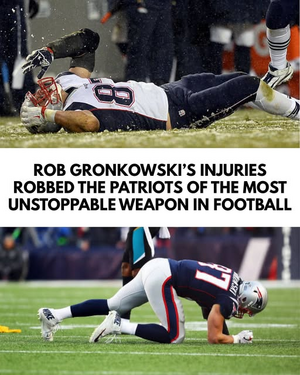
Two weeks earlier, during the AFC Championship against the Baltimore Ravens, Gronkowski suffered a severe high ankle sprain while being tackled near the sideline. The injury left him barely able to practice leading up to the Super Bowl.
He played anyway.
That’s the part Patriots fans remember most.
Gronkowski took the field in Indianapolis despite being clearly limited. The explosiveness that usually defined his game wasn’t there. The cuts were slower. The separation never quite happened.
He finished the Super Bowl with two catches for 26 yards.
For a player who had terrorized defenses all season, it felt like watching a completely different version of him.
And the Patriots offense never fully recovered.
The Giants’ pass rush pressured Brady throughout the game, and without a fully healthy Gronkowski stretching the middle of the field, New England struggled to create the same mismatches that had powered them all season.
The Giants won 21–17.
The Patriots dynasty would continue, but that moment left a lingering question.
What happens if Gronkowski is healthy?
Because at his peak, there wasn’t a defensive scheme in football that could eliminate him. His size, strength, and route-running created the kind of matchup nightmare coaches spend entire weeks trying to solve.
In 2011, he was the Patriots’ most dangerous weapon.
But injuries would follow him throughout his career. Broken arms. Back surgeries. Knee problems. Each one chipped away at the time the league got to watch the most dominant tight end it had ever seen.
And in the biggest game of that season, the Patriots had him on the field.
Just not the version that had terrorized the NFL for five straight months.